
The Sigmoid Curve: Patterns Before Plateau
Most businesses do not stall overnight. The shift usually begins while things still look good.
Every growing business follows a rhythm.
There is the beginning, where resources are thin, and the work asks more of the owner than it gives back. Then comes the climb, when the business starts to prove it can create momentum more than once. Eventually, something shifts. What once created progress begins to create pressure.
That pattern is known as the Sigmoid Curve.
What Is the Sigmoid Curve, Really?
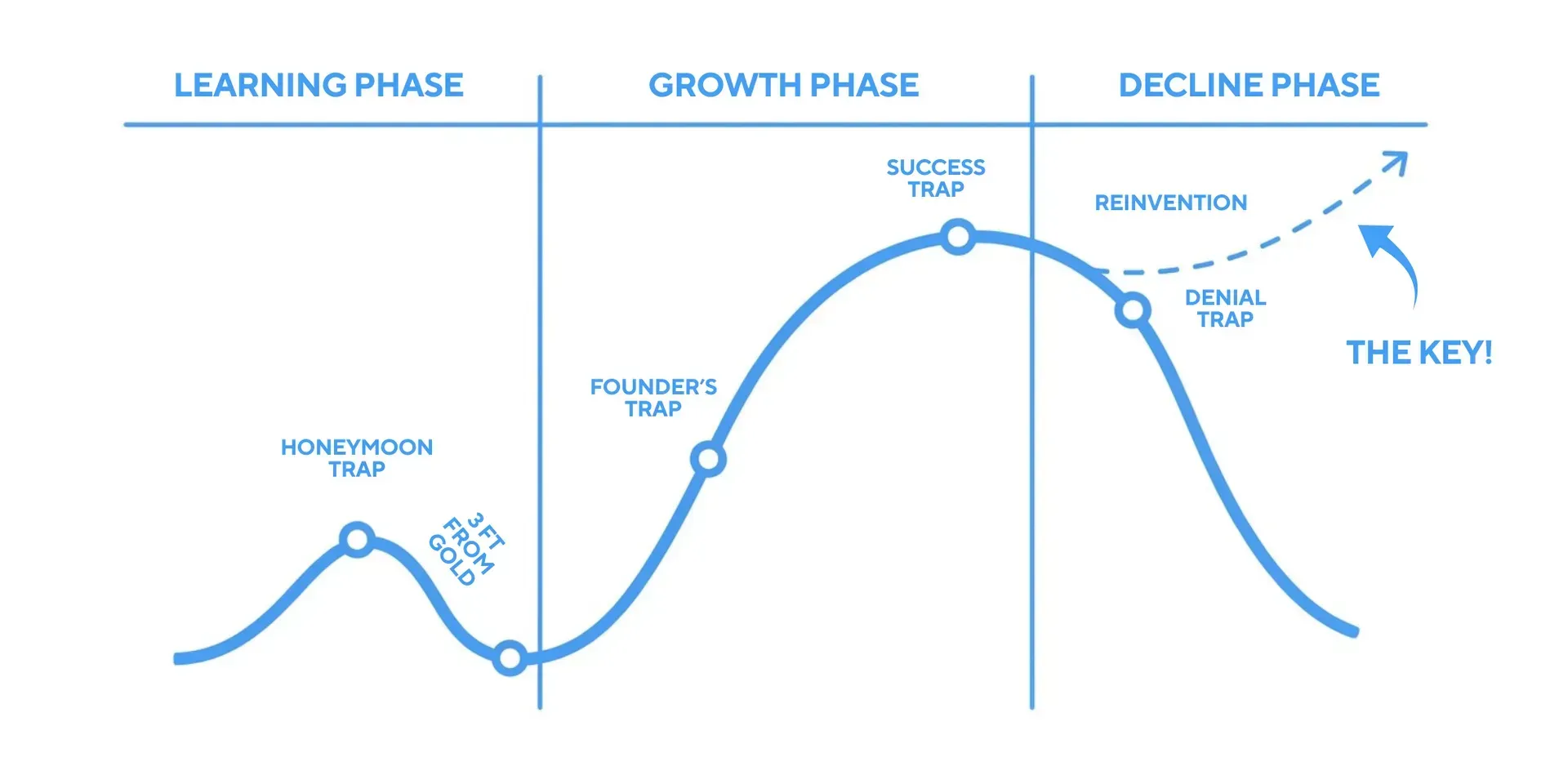
The Sigmoid Curve is the shape of a business life cycle. It begins with learning, moves into growth, and reaches the point where the business must either stall or reinvent.
This framework gives owners a way to name what they may already be feeling.
The curve can apply to the business as a whole, but it can also show up inside a team, a product, or a major initiative. One part of the company may still be climbing while another is already showing signs of strain.
Knowing where you are on the curve matters because growth is rarely lost all at once. It usually starts with signals that are easy to explain away.
Where Are You on the Curve Right Now?
Early on, much of the work is trial and error, often with money you cannot afford to waste. This is the Learning Phase, where many businesses stop not because the idea was wrong, but because the discomfort lasted longer than expected. The work here is not to protect the plan. It is to protect the vision.
At a certain point, the business stops feeling so fragile. The market has started answering back. This is the part of the curve most owners work hard to reach, but it is also where success can start dulling the discipline that made it possible. That is the Honeymoon Trap: momentum feels so promising that the owner assumes it will last.
As growth continues, the Founder’s Trap can follow. The business has expanded, but too much still has to pass through the owner. It is bigger, but not necessarily stronger.
This is the point before plateau. It rarely announces itself as a problem. The business may still look strong, but growth has begun creating more friction than progress. That is what makes the Success Trap so difficult to catch. The current model is still producing results, which makes it harder to question. But leadership is not only tested in a downturn. It is tested when the business is still winning, and the next version of the company has to be built before everyone else can see why.
Decline often starts before the numbers show it.
The business keeps growing, but its structure does not grow with it. Pressure gets absorbed instead of redesigned.
This is how the curve turns. The business does not fail all at once. It becomes constrained by the very habits that once helped it grow. That is the Decline Phase. Not necessarily failure, but evidence that the business has outgrown the way it is currently being led. Caught early, it can become the moment the owner stops defending what used to work and starts building the next curve with intention.
That is the real value of the Sigmoid Curve. It helps leaders recognize pressure before it becomes decline. The friction you feel may not be random. It may be the first sign that the next curve needs to begin.
by The Point Success Guide in Strategy Posted on 14/07/2026 15:15